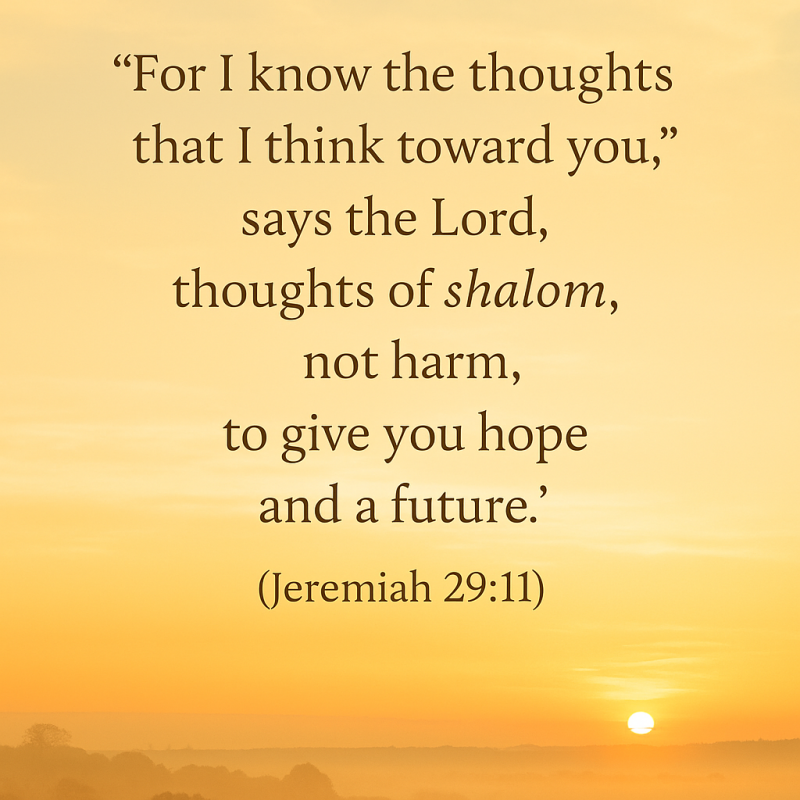
“For I know the thoughts that I think toward you,” says Yahweh, “thoughts of peace, and not of evil, to give you hope and a future.”
Context (The 5 W’s)
-
Who: God speaks through the prophet Jeremiah to the Israelite exiles in Babylon.
-
What: A letter of encouragement to a people who felt abandoned after being taken captive.
-
When: Around 597–586 BC, during the Babylonian exile.
-
Where: The message was sent from Jerusalem to Babylon.
-
Why: The people were discouraged and listening to false prophets promising a quick return home. God, instead, assured them that He had a long-term plan that required trust and patience.
They gathered at dawn.
The air was heavy with smoke from yesterday’s cooking fires and the scent of strange spices from Babylonian markets. Nothing smelled like home anymore. Nothing felt familiar. The people were weary — their language mocked, their temple destroyed, their songs silenced.
When the messenger arrived, even the wind seemed to hush. He held a worn scroll — a letter from Jeremiah, the prophet who hadn’t been exiled with them. The man’s hands shook slightly as he unrolled it. No one dared speak.
The first words weren’t anger.
They weren’t punishment.
They were remembrance.
“For I know the thoughts that I think toward you,” says the Lord,
“thoughts of peace, not harm, to give you hope and a future.”
You could almost hear hearts breaking in the silence that followed. Some people wept openly. Others just closed their eyes and let the words sink deep.
For years they’d wondered if God had forgotten them — if He’d finally given up. But now, in this strange land, He sent a message that said, I still see you.
It wasn’t a promise of instant rescue.
It was something harder — but truer.
God was saying, “You’ll be here for a while. Build homes. Plant gardens. Raise your children. Seek the peace of this place, because even in exile, I am working.”
Those words changed everything.
Hope didn’t look like leaving anymore — it looked like living right where they were.
As the sun lifted higher, golden light spilled across their faces. Someone smiled through tears. Someone whispered the word shalom — not just peace, but wholeness, restoration, healing.
They were still in Babylon.
But they no longer felt abandoned.
Because God’s plan hadn’t been broken — just delayed.
And even here, surrounded by loss, the future had begun again.
Cultural & Historical Insight
This verse is often quoted as a personal promise—but it was originally given to an entire nation in exile, not an individual.
God was telling them that His plan included seventy years in Babylon before their restoration (Jer. 29:10).
The “peace” (Hebrew: shalom) meant more than calm feelings; it referred to wholeness, well-being, and restoration—a life aligned with God’s covenant purposes.
So, Jeremiah 29:11 wasn’t an instant “everything will be fine” verse—it was a call to endurance and trust during captivity.
Hidden Truth
God’s goodness doesn’t always look like immediate relief.
Sometimes His plan includes seasons of waiting, pruning, or exile, all to prepare His people for a greater restoration.
Hope here isn’t a wish—it’s a confident expectation anchored in God’s faithfulness.
| Scripture | Connection |
|---|---|
| Romans 8:28 | "All things work together for the good of those who love God" |
| Philippians 1:6 | “He who began a good work in you will carry it on to completion.” |
| Isaiah 55:8–9 | “My thoughts are not your thoughts... My ways are higher.” |
Application
Even when life feels uncertain or delayed, you can rest knowing that God’s plan is still moving.
You may be in a “Babylon” season—feeling stuck, disciplined, or far from where you want to be—but He is still the Author of your future.
Seek His presence where you are, plant roots, grow, and trust His timing.
These all echo the same theme: God’s long-term plans for redemption often differ from our short-term expectations.
Lord,
When I can’t see the path ahead,
Remind me You’ve already drawn the map.
When the wait feels endless,
Teach me that Your timing is mercy.
You are not late; You are intentional.
Let my hope rest not in outcomes,
But in the One who holds my future—
Faithful, unchanging, and true.

I am searching for Beta Readers for my memoir: Walking with God through Grief. If you would like to get early access in exchange for a review and provide suggestions for how I can be clearer. Please reach out at Hopescribed@outlook.com
Add comment
Comments