“The one who offers thanksgiving as a sacrifice honors Me…”
This is the songs I created for Thanksgiving. I needed something to keep me grounded in Jesus. The past few weeks have been difficult and painful. I truly hope you like the music. If you like to support my ministry, I would be grateful. I pray God blesses you.

I didn’t understand what it meant to offer thanksgiving as a sacrifice. Not at first. Not until the year everything came undone.
Work had thinned out, and the mill laid off half its laborers, and I was among them. Food grew scarce. Friends I depended on moved away, chasing survival in other cities. Fear, the kind that clings to your ribs, settled in like an unwanted guest.
The gatherings at Lydia’s home became my only steady thing.
But even there, I felt out of place. Everyone else seemed to carry such quiet strength. I walked in with shaking hands and questions that burned.
One evening, after the letter from Paul had been read, one of the elders opened the Psalms. His voice was rough from age, slow but sure, and he read: “The one who offers thanksgiving as a sacrifice honors Me…”
A sacrifice. Not a feeling. Not a song sung easily. Not a moment of abundance. Something given when it hurts to give it. I didn’t like the sound of that. I didn’t want to offer God a heart full of ache. I wanted to offer Him something whole.
Something worthy.
But that night, when I returned home, the house felt empty.
The oil jar was nearly dry. My stomach cramped with hunger I didn’t want to acknowledge. I sat on the floor, back against the wall, and whispered: “I have nothing to give You.”
The room stayed still, but something inside me trembled awake. A sacrifice isn’t given from what you have in plenty. A sacrifice is given from what costs you.
I closed my eyes and prayed words I barely believed: “Thank You… for being near me even in this.” My voice cracked. It didn’t feel holy. It didn’t feel honorable. It felt like breaking. But as I spoke, something shifted in the silence. Not my circumstances, my stomach, or the scarcity. Just this: I felt God there.
With me. Not asking me to pretend. Not demanding joy. Not waiting for me to be stronger. Just present. Present in a room that still smelled like empty jars and worn-out hope.
Over the next weeks, I practiced thanksgiving the way it was meant, not as decoration, but as surrender. When bread appeared unexpectedly, I whispered thanks. When I made it through a day without collapsing under worry, thanks.
When someone shared from their table, thanks. When nothing changed at all, thanks.
Not because the pain disappeared, but because God stayed.
That’s when I understood what the psalmist meant: thanksgiving becomes a sacrifice when it rises from a place that hurts. When it costs pride. When it costs control.
When it costs the illusion that I’m managing life on my own.
Thanksgiving is not for the one with full hands, it’s for the empty. It’s the offering only the broken can give. Now, when we gather and read the Psalms, I hear the words differently: “The one who offers thanksgiving as a sacrifice honors Me…”
And I think: I have honored Him more with my trembling gratitude than I ever did with my confident praise. Because now I know that Christ meets me in the places where thanksgiving feels impossible, and He holds me steady enough
to offer it anyway. Even here. Especially here.
Cultural & Historical Insight
In ancient Israel, sacrifices were costly—animals, oil, grain, resources from a family’s survival. But Psalm 50 shocks its original audience by revealing that God is not hungry and God is not impressed by offerings that cost nothing internally. He makes a distinction:
External sacrifice = easy.
Internal sacrifice = holy.
Thanksgiving wasn’t a polite “thank You.” It was:
-
A spoken declaration of trust
-
Offered in the presence of others
-
Given in seasons of lack
-
A confession that God was still God even when life wasn’t easy
This psalm confronts the human instinct to praise only when circumstances make sense. For ancient Israel—and for us—God says:
“I want the gratitude that rises from the place where you don’t feel grateful yet.” That is the thanksgiving that honors Him.
| Scripture Connection | Verse |
|---|---|
| Jonah 2:9 | thanksgiving from the belly of the fish |
| Habakkuk 3:17–18 | “Though the fig tree does not blossom… yet I will rejoice” |
| 1 Peter 1:6–7 | faith tested by fire becomes praise |
| Acts 16:25 | Paul and Silas singing in prison |
Scripture repeats it:
Thanksgiving is strongest when circumstances are weakest.
Early Church Insight
The early believers understood this verse instinctively because their lives were lived in pressure:
-
loss of jobs
-
rejection by family
-
hunger
-
mob hostility
-
persecution
-
scarcity
-
uncertainty
To them, thanksgiving was not mood-driven.
It was a spiritual offering.
Ignatius wrote on his way to martyrdom:
“Let our thanksgiving remain though our chains remain.”
Clement said:
“The gratitude that rises from suffering is the praise that reaches heaven.”
For the early church, thanksgiving wasn’t a warm feeling.
It was a war cry of trust.
They offered praise not because they were comfortable—
but because Christ was present.
Church Fathers & What They Taught About Sacrificial Thanksgiving
Clement of Rome (AD 35–99)
One of the earliest post-apostolic leaders wrote:
“Let our thanksgiving be steadfast, not born of ease, but of knowing that He is near.”
Clement lived during real persecution, yet taught believers to anchor themselves in presence, not pain.
Polycarp (AD 69–155)
A disciple of the apostle John, Polycarp wrote:
“In every distress let us offer thanks, not because we are distressed, but because Christ does not abandon us.”
This distinction is crucial:
The early church never glorified suffering. They glorified the God who stayed with them in it.
John Chrysostom (AD 349–407)
Chrysostom preached on this psalm during real political pressure and famine. He said:
“He who gives thanks in sorrow glorifies God more than he who gives an offering in prosperity.”
But he also corrected the extremes of his day:
“We do not run toward affliction; we endure it when it comes. God is honored not by pain, but by faith.”
Chrysostom ALWAYS emphasized balance
Suffering is not holy.
Faith in suffering is.
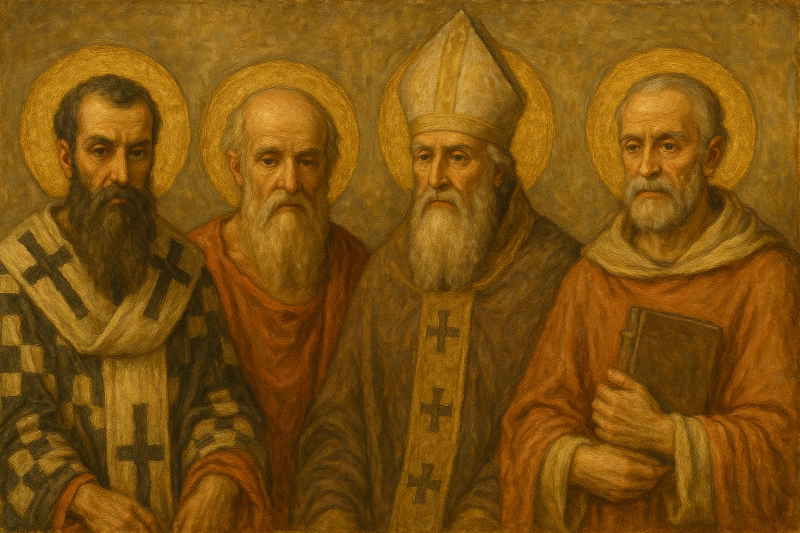
Athanasius (AD 296–373)
Athanasius wrote that thanksgiving from hardship is not God demanding suffering, but God receiving trust:
“Thanksgiving offered in tribulation is not delight in the pain, but confidence in the One who delivers.”
He warned believers never to seek suffering, only to seek Christ within it.
Origen (AD 184–253)
Origen recognized thanksgiving as a spiritual discipline when life is difficult:
“The soul that trusts God in hardship offers a sweeter incense than the one who praises Him in abundance.”
But he also warned believers not to manufacture suffering:
“We do not commend misery, but faith.”
Hidden Truth — The Verse We Misread
Modern theology often treats thanksgiving as:
-
a vibe
-
a spiritual optimism
-
an emotional state
-
a praise report after the breakthrough
But Psalm 50:23 flips that on its head.
Thanksgiving is a sacrifice.
It means:
-
giving thanks when you’re empty
-
trusting God when you feel abandoned
-
offering Him your honesty, not your polished strength
-
choosing gratitude when fear feels louder
-
surrendering control when nothing is resolved
God isn’t looking for forced positivity.
He’s looking for faith that costs something.

Application — What This Means For You
This verse calls you to a deeper, more honest thanksgiving—one that doesn’t wait for resolution.
Thanksgiving as sacrifice means:
-
“I trust You when I don’t understand.”
-
“I bless You even while I’m hurting.”
-
“I honor You with my surrender, not my success.”
-
“I thank You because You’re present, not because the situation is fixed.”
This kind of gratitude changes you.
Not the circumstance—you.
Because sacrificial thanksgiving is:
🌿 stabilizing
🌿 clarifying
🌿 humbling
🌿 deepening
🌿 transformative
It pulls your eyes off what you lack and anchors your heart in the God who does not leave.
Abba,
Teach me the kind of thanksgiving
that rises from the places that ache.
The kind that doesn’t wait for answers
or healing, or clarity, or resolution.
Teach me the gratitude that becomes a sacrifice,
the offering that costs my pride,
my need for control,
my fear of tomorrow.
Receive the trembling thanks I bring today.
Not perfect, but honest.
Not strong, but surrendered.
Not full-handed, but open-hearted.
Be honored in the praise
that comes from the middle,
from the struggle,
from the unfinished places of my life.
And let Your presence
turn my small, costly offering
into worship that reaches heaven.
Amen.
If my content blessed, you and you want to contribute to my ministry click the coffee cup below. Starting next year, I will be making some changes that will open the door for me to push this blog to the max, and I can't wait to see what God has in store for us all. I hope you join me on this adventure. I plan to divide up the content. Those who want the short brief to run down will be happy that you will be able to quickly get the details and get to work for those who like to linger you too will be happy. I have created a tiered level system for those who really want to go deep into God's word with me. I literally could spend all day just reading about all God has done.
That said leave a comment below. Let me know what you think. Please LIKE, COMMENT AND SHARE! Without your help I can't do it all by myself.
Add comment
Comments